Marginalia
Sign inA reader with a memory
You used to be able to read for an hour.
Marginalia is somewhere to keep the books you mean to finish — your own EPUBs, PDFs and scans — with a companion beside the page that has read exactly as far as you have. No feed, no algorithm, and nobody selling what you read.
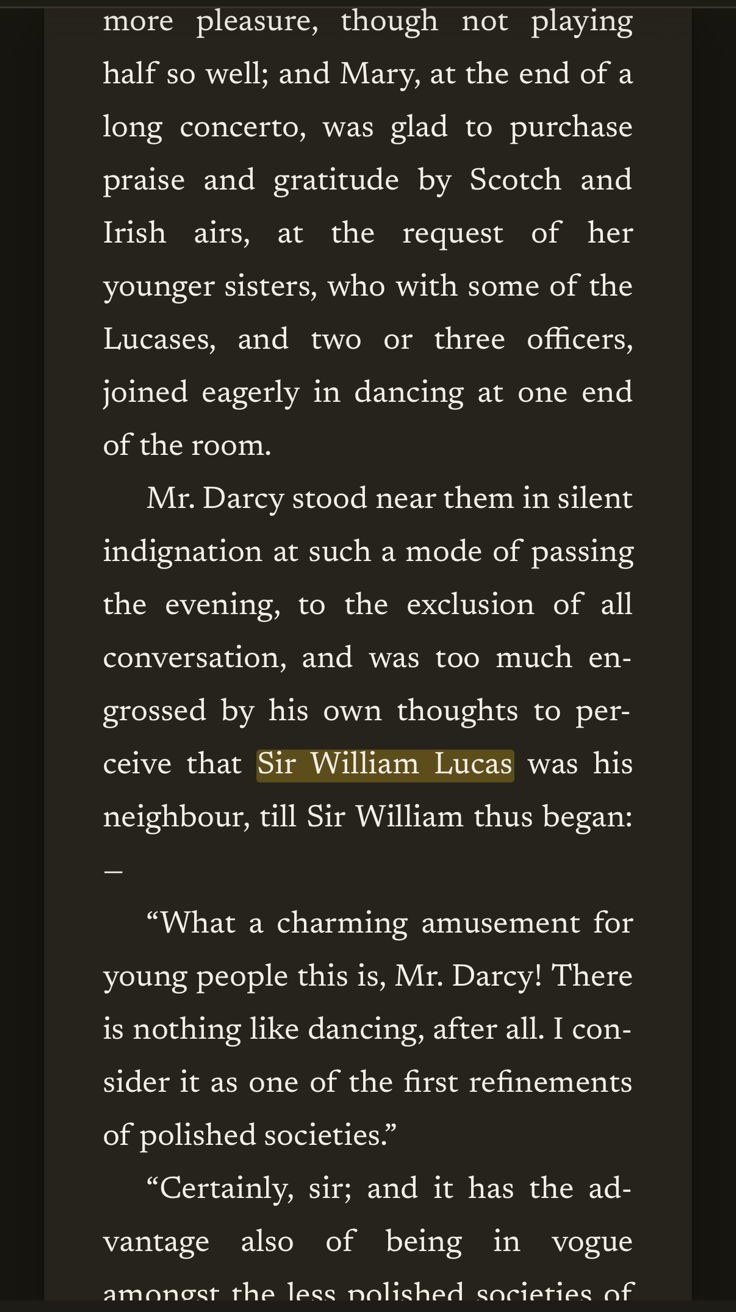
Pride and Prejudice — one of the free books, opened and marked.
01Ask without being spoiled
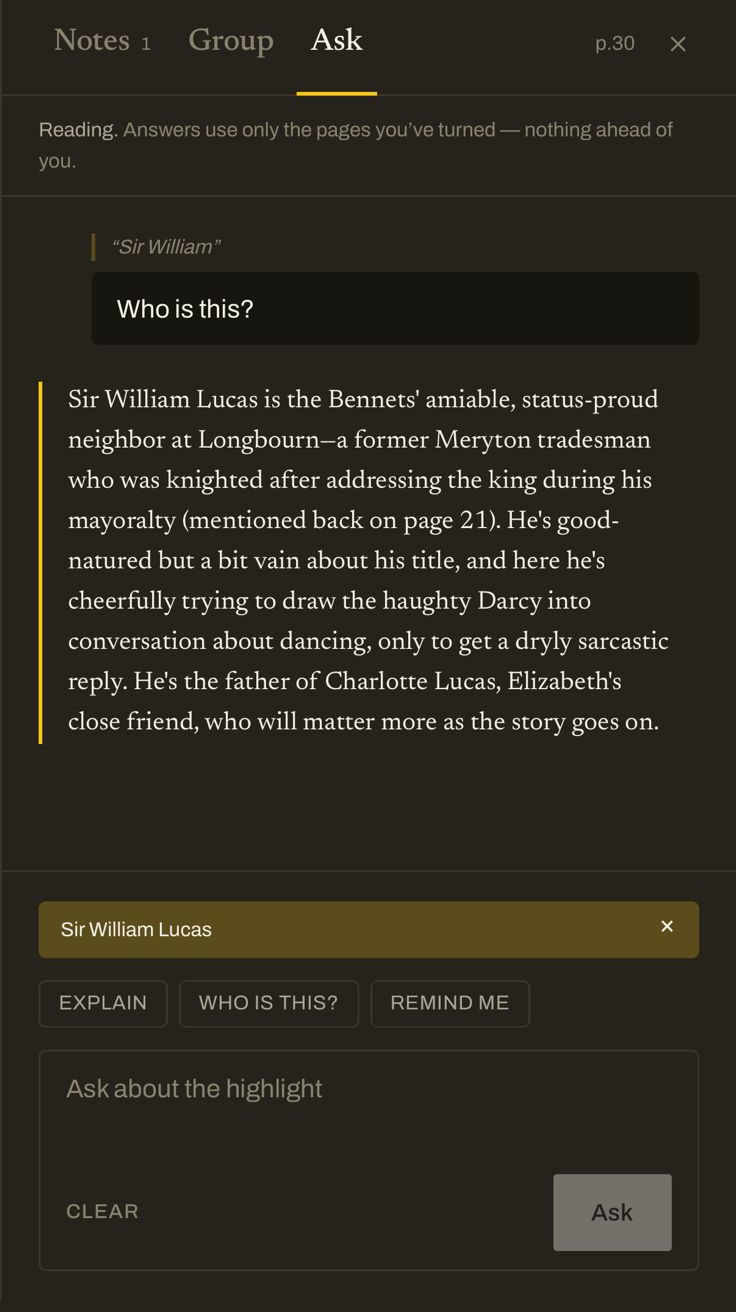
Highlight anything and ask about it. The answer comes from the pages you have already turned and never from the ones ahead — so you can ask who somebody is on page 100 without being told what becomes of them on page 300.
Reading a textbook instead? Say so, and it draws on the whole book and tells you the page. It is the same companion; it just stops protecting a plot that isn’t there.
In the answer beside this, note where it stops: page 21, already read. Page 300 is not consulted.
0273 books to start with
An empty shelf is the hardest part of any reader, so yours isn’t. These are out of copyright, free to keep, and already prepared — one tap and you are reading.
Finish it this week
- The Yellow Wallpaper · Charlotte Perkins Gilman30 min
- The Metamorphosis · Franz Kafka1 hr 30 min
- Dr Jekyll and Mr Hyde · Robert Louis Stevenson2 hr 30 min
- A Christmas Carol · Charles Dickens3 hr
- The Time Machine · H. G. Wells3 hr
- Heart of Darkness · Joseph Conrad3 hr
- Flatland · Edwin Abbott Abbott3 hr
- A Modest Proposal · Jonathan Swift25 min
- The Importance of Being Earnest · Oscar Wilde1 hr 35 min
- A Doll’s House · Henrik Ibsen2 hr
- Hamlet · William Shakespeare2 hr 20 min
- The Turn of the Screw · Henry James3 hr 5 min
And 61 more once you are in — novels, mysteries and voyages, arguments and lives, and a shelf of the ones you were read to from. Austen, Dickens, Dostoevsky, Dumas, Tolstoy, Twain, the Brontës, Du Bois, Christie, Conan Doyle.
03Or tell it you are studying
Mark a book as one you are working through and the companion changes its manners. It reads the whole thing rather than only what you have passed — a definition needed on page 40 is usually printed on page 312 — and it cites the page for every claim, so you can check it and then quote the book rather than the assistant.
It keeps the book’s own terminology and notation instead of paraphrasing them into something an examiner will not recognise. And where the book does not cover what you asked, it says so and answers from general knowledge — labelled as such, so you always know which of the two you are reading, and which one you can cite.
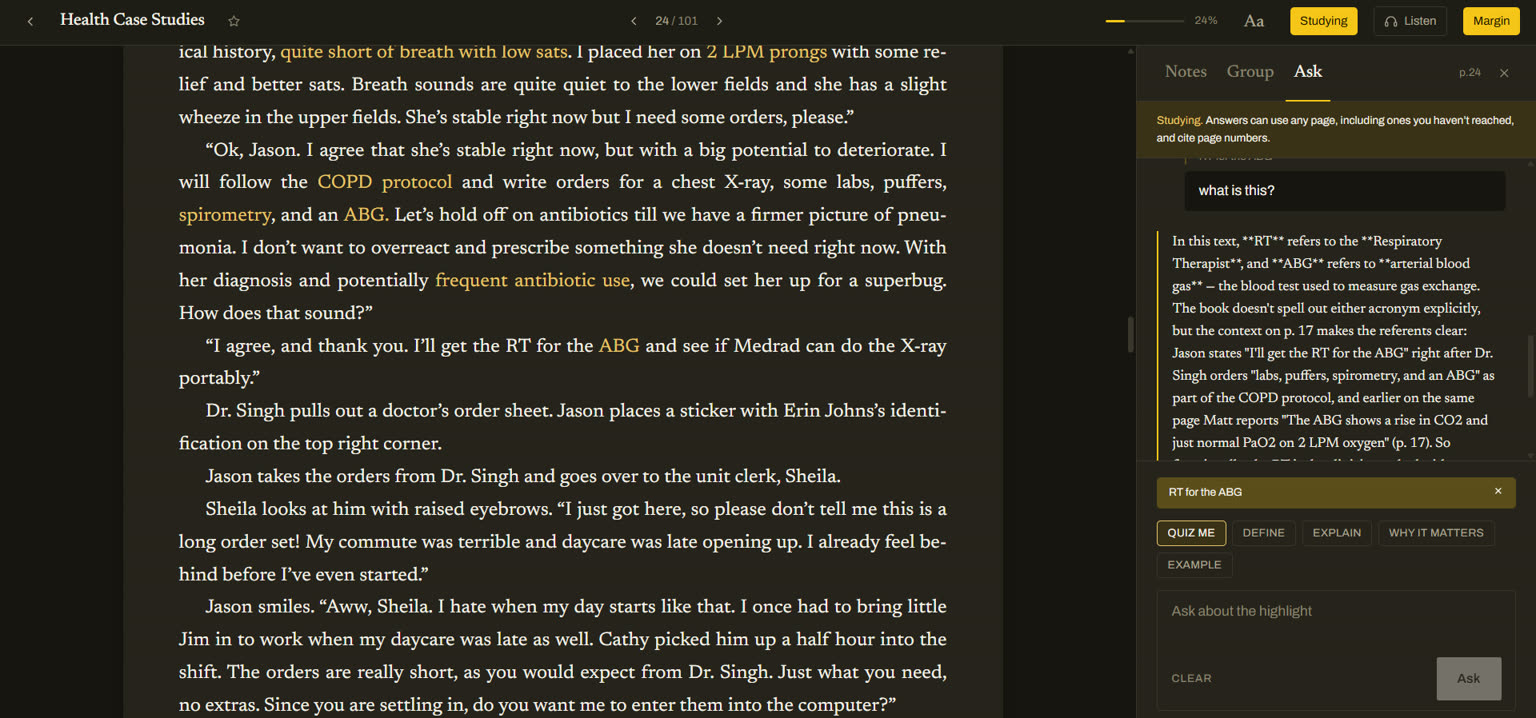
Asked what two abbreviations meant, it answered them, said plainly that the book never spells either one out, and cited the page whose context settles it. Both halves, in one answer.
04One set of notes, not six
A group is people reading the same copy of the same book. Highlights and notes shared to it turn up in the margin beside the page they were written on, so a reading group or a set of coursemates builds one annotated copy between them instead of six separate ones.
Nothing is shared unless you say so, and you say so twice: a single note, or one book’s notes opened to one group. The shelf around it stays private, and leaving the group takes your notes back out with you.
05Margins that survive the book
Highlights and notes are anchored to the words rather than to a page number, so they hold when the text reflows on a different screen. All of it is searchable, exportable and yours — the reason to write in a book is being able to find it again.
And the files themselves never leave the machine you added them to. Nothing is uploaded, and we could not hand your library to anyone if we were asked. What syncs is the part that is useful across devices: your shelf, how far you have got, and everything you wrote in the margins.
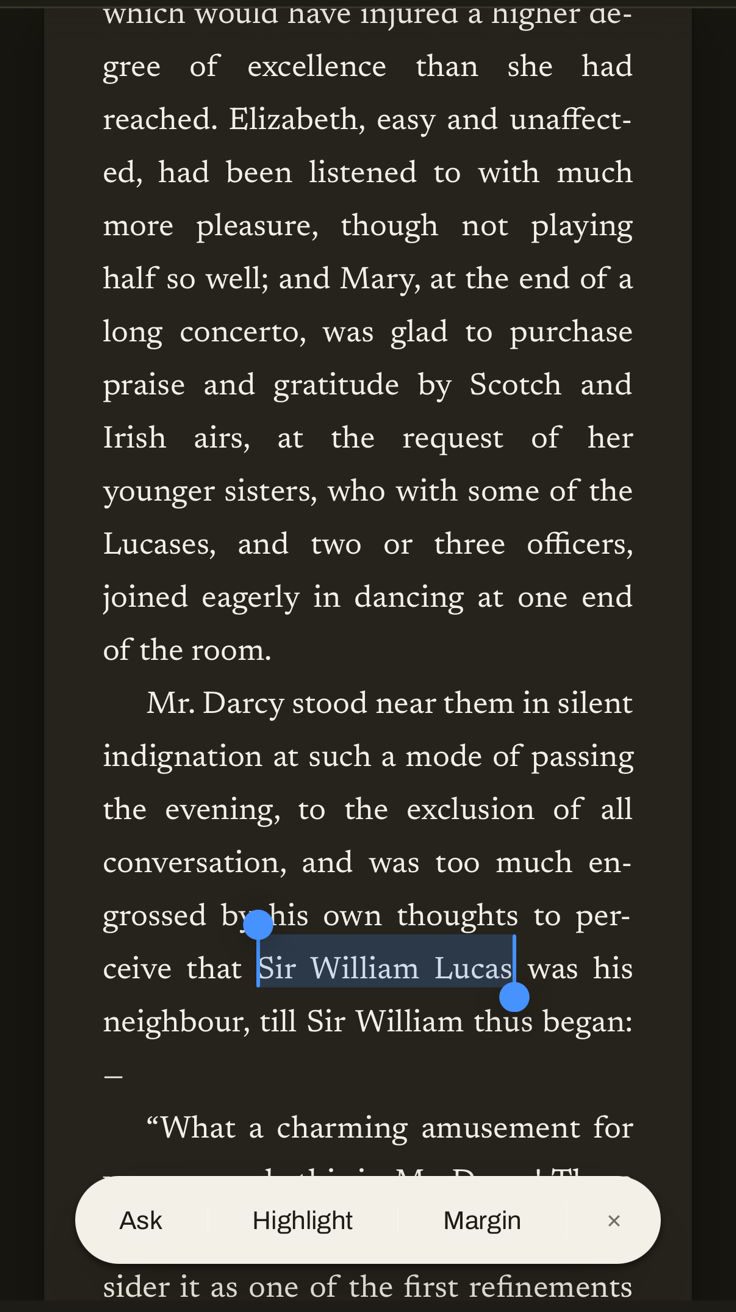
Choosing is the browser’s own — the same press and drag as anywhere else on the device. What the app adds is one bar, along the bottom where a thumb already is, and only once you have stopped choosing.
06What it costs
Free to start, and free is the whole reader: every book, every highlight, every note, the margins, the groups. What the free plan limits is how often you can ask — a couple of questions a day — because that is the part with a bill behind it.
Pro is $8 a month, or $80 for a year, for our most capable model and three hundred questions a month. It is better at the things that are actually hard: a study question with a page to cite, or an answer that needs several parts of a book held together at once.
The rest of your subscriptions are competing for your attention. This one is trying to give it back.
See the plans →The hour is still there. Start with something short.
© 2026 Marginalia · Terms · Privacy · Refunds · support@marginaliareader.com